
Aprilaire Air Duct Cleaning in Gainesville: A Homeowner’s Guide
An Aprilaire MERV-13 filter can’t clean the debris that’s already coating your duct walls. It only captures what flows through it going forward. That’s the gap most Gainesville homeowners miss: you can buy excellent filtration and still breathe the same recirculated dust, because the filter sits downstream of the mess. A whole-home air cleaner is a capture device, not a cleaning device. If the ductwork feeding it is dirty, you’ve installed a very good filter into a very dirty highway.
This guide covers how Aprilaire filtration actually integrates with your duct system, what to inspect before any upgrade, and how to care for a system that’s already running Aprilaire equipment in Gainesville. If you’d rather not sort through it yourself, call (855) 408-4151.
Key Takeaways
- Aprilaire filters capture particles passing through them; they cannot remove debris already settled or adhered inside ducts.
- Higher-MERV filtration raises static pressure, which matters more in flex duct systems than in rigid metal runs.
- Cleaning before installing filtration protects the investment. Cleaning after years of filtration use still matters, because filter housings and the plenum collect buildup.
- Bypass checks and filter change intervals on Aprilaire systems differ from a standard one-inch filter setup.
How does Aprilaire filtration integrate with existing ductwork?
Aprilaire whole-home air cleaners mount at the return-air side of your air handler, usually inline with the return plenum or the filter cabinet. Air passes through the media pad before reaching the blower and evaporator coil. That placement is deliberate: it protects the coil from dust loading, which is why Aprilaire equipment pairs well with duct systems that are already clean and well-sealed.
Here’s the part that gets skipped. Filtration hardware is a downstream component. It changes nothing about what’s upstream of it – the return grilles, the trunk lines, the branch runs feeding each room. In our experience across Gainesville homes, the return side is routinely the dirtiest section of the system, because it pulls from floor-level living space where dust, pet hair, and pollen settle.
So when you install or upgrade Aprilaire filtration, the sequence matters:
- Inspect the duct interior, not just the grilles. A camera inspection tells you what the walls actually look like.
- Clean the system, including the return plenum and the air handler cabinet, before hanging new filtration hardware.
- Seal the accessible joints and any disconnected flex connections so filtered air doesn’t get bypassed by unfiltered air from a crawlspace or attic.
- Then commission the Aprilaire unit with the correct media pad for your target filtration level.
Skip step two and a new high-efficiency filter starts loading immediately with debris that should have been removed first – shortening pad life and masking a duct problem as a filter problem.
What should a duct inspection cover before a filtration upgrade?
A pre-installation inspection should answer four questions: how much debris is in the system, where it’s concentrated, whether the ducts leak, and whether airflow is adequate for the filtration level you want. Anything less is a sales visit, not an inspection.
In Gainesville homes specifically, we look at:
- Return trunk condition. Often the worst offender. Floor grilles and short return runs collect the majority of visible buildup.
- Flex duct runs. Common in this region’s residential construction. Flex is easy to install and easy to crush, sag, or disconnect – all of which create pressure problems and leak points.
- Air handler and coil. A loaded coil restricts airflow and can look like a duct problem when it isn’t.
- Filter cabinet fit. Gaps around a filter slot let air bypass the media entirely, which drops effective filtration far below the rated MERV.
- Static pressure reading. Measured, not guessed. This is the number that determines whether a higher-MERV upgrade is safe for the existing blower.
A camera inspection is the only honest way to see duct interiors. When we inspect, we run a Rotobrush camera through the runs so the homeowner sees the same thing we do. Transparency here matters, because the difference between a lightly dusty system and a heavily loaded one changes the recommendation entirely.
Why do higher-MERV filters raise static pressure in Gainesville flex duct systems?
Every filter adds resistance to airflow, and denser media adds more. A MERV-13 Aprilaire pad is more restrictive than the thin one-inch filter it replaces. That resistance shows up as higher static pressure – the system’s back-pressure – and it has to go somewhere.
The practical effect: the blower pushes against more resistance, delivers less airflow to the rooms, and works harder doing it. In a rigid metal duct system with generous sizing, there’s usually room for that. In a flex duct system with long runs, tight bends, or undersized returns, there often isn’t.
What that looks like for a Gainesville homeowner:
- Rooms at the end of long flex runs feel weak on airflow.
- The system runs longer to reach setpoint, which shows up on the utility bill before it shows up anywhere else.
- The evaporator coil gets colder than it should, which invites condensation and, over time, biological growth on a wet coil.
- Duct joints that were marginally sealed start leaking under the added pressure.
None of this means high-MERV filtration is a bad idea. It means the duct system has to be assessed first. Cleaning a loaded system lowers resistance. Sealing disconnects lowers it further. Both can offset much of the pressure increase from the denser pad. Measuring static pressure before and after is how you know the upgrade is a net positive rather than a trade.
How do you maintain an Aprilaire-equipped system differently?
An Aprilaire system needs more attention in some places and less in others than a standard setup. The differences are specific.
Filter change intervals. Filter media loads from the inside out, and a visibly gray pad is already well past its useful life. Change based on pressure drop across the media, or on a schedule tied to what the filter is catching – a home with pets and open windows through a Gainesville spring loads faster than a tightly closed house. Don’t stretch intervals to save on pads; a loaded pad is the same as a restricted duct.
Bypass checks. Some Aprilaire configurations use a bypass setup, and bypass dampers or ductwork can drift out of adjustment. A bypass that’s open when it shouldn’t be lets air skip the media. Check it as part of routine service.
Cabinet and housing cleaning. The filter cabinet and the plenum behind it collect debris that the pad doesn’t capture. Wipe-down and vacuum of the cabinet belongs in the annual routine.
Post-filter duct checks. The ductwork downstream of the filter is cleaner by design, but not sterile. Grilles, registers, and diffusers still collect dust from room-side air, and those are worth cleaning periodically.
Coil condition. A well-filtered system keeps the coil cleaner, which is the main financial payoff of Aprilaire equipment over time. Have the coil inspected, not just the filter.
We clean and repair duct systems, and we’re familiar with Aprilaire and Honeywell equipment because we work around it. We don’t sell filtration hardware. That’s a useful separation for a homeowner: the recommendation about your ducts and the recommendation about your filter aren’t coming from the same invoice.
What does professional duct cleaning look like in an Aprilaire-equipped home?
It looks different from a standard residential job in a few concrete ways. The filtration hardware has to be protected and, in some cases, temporarily removed. The plenum and cabinet get more attention. And the documentation standard should be higher, because the homeowner has already invested in air quality and deserves to see the before-and-after.
What we do on every job, filtration present or not:
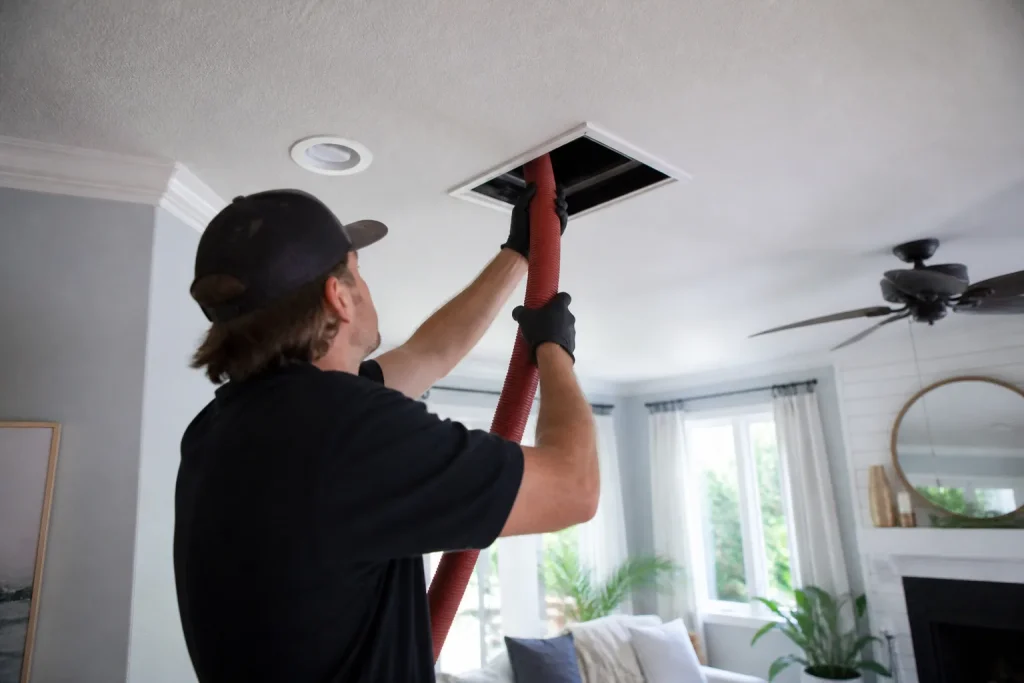
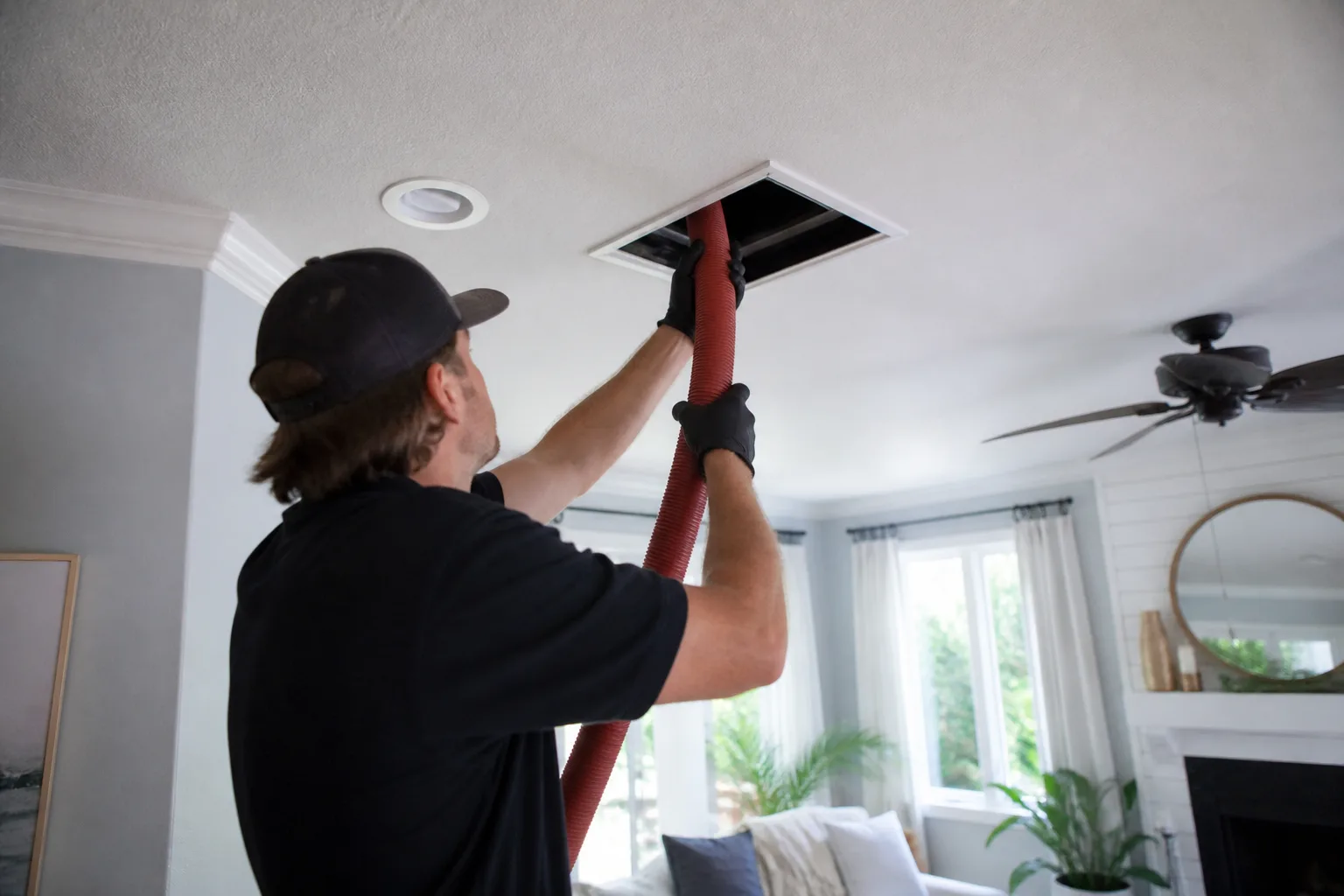
- Rotobrush rotary brush equipment to agitate debris off duct walls – not a shop vac and a hand brush.
- Nikro negative-air vacuum equipment to hold the system under negative pressure so dislodged debris goes into the machine, not into your living room.
- Abatement Technologies filtration to capture fine particulate at the working area.
- Before-and-after photos of the interior of the ducts, so you can see what changed.
On an Aprilaire-equipped system, we isolate the air cleaner before cleaning, then clean the housing itself, verify the bypass is set correctly, and reinstall the media per the manufacturer’s spec. The result is a duct system that supports the filtration hardware instead of fighting it.
For more on the core service, see our page on air duct cleaning. If a run has torn, crushed, or disconnected, that’s air duct repair. And because a leaky or blocked dryer vent is a fire-safety issue independent of your HVAC system, dryer vent cleaning is a service worth scheduling on its own schedule.
Our technicians have up to 9 years of experience, with the equipment to match. If you’d rather have someone look than guess, we’re happy to be that someone.
When should you call a pro instead of handling it yourself?
Some maintenance is homeowner work: swapping an Aprilaire media pad, wiping grilles, checking a bypass damper position. Duct interiors are not. The tools to do it right – rotary brush systems, negative-air vacuums, containment filtration, cameras – are not homeowner tools, and a shop vac pushed into a register mostly just redistributes dust into the room.
Call a professional when you see any of these:
- Visible debris or buildup inside a register boot when you remove the grille.
- Persistent dust on surfaces shortly after cleaning the house.
- Weak or uneven airflow to some rooms, especially at the end of long flex runs.
- A filter that loads quickly, which often points to upstream debris rather than a bad pad.
- A coil or blower that looks dirty despite consistent filter changes.
Related services in Gainesville: Holloway Air Duct Cleaning handles air duct cleaning, air duct repair, and dryer vent cleaning together, so a related problem doesn’t turn into a second contractor.
The Bottom Line
Aprilaire filtration and clean ductwork are not competing investments – they’re the same investment at two stages. The filter captures what flows through it. The duct system determines what’s available to flow. Cleaning first protects the filtration hardware and the indoor air quality gains you paid for. Cleaning after years of use still matters, because housings, plenums, and grilles collect debris the media never touches. And measuring static pressure before raising MERV is the single most skipped step we see.
If you’re in Gainesville and need help, Holloway Air Duct Cleaning offers free estimates – call (855) 408-4151. We answer 24/7. Fast dispatch from 7am to 7pm, Sunday through Friday. Every job gets one flat price per system agreed before work starts, before-and-after photos of your own ducts, and the right machine for the job.
Frequently Asked Questions
No. An Aprilaire filter captures particles passing through it and never removes debris already settled or adhered inside the ducts. Filtration and duct cleaning address different stages of the same problem, and a system with heavy buildup will load a new filter faster than a clean one.
Not if the duct system can handle the added static pressure, which is why a pressure reading comes before an upgrade. In flex duct systems with long runs or undersized returns, a denser filter can reduce airflow and stress the blower. Cleaning and sealing the ducts first usually makes a higher-MERV pad a safe choice. Call (855) 408-4151 for an exact quote – estimates are free.
There’s no fixed number that fits every home. Homes with pets, open windows through pollen season, recent renovation, or a system that’s never been cleaned tend to need it sooner. A camera inspection is the honest way to decide, rather than a calendar rule. Call (855) 408-4151 and we’ll inspect before we recommend – estimates are free.
We quote one flat price per system based on what’s actually in your ductwork, agreed before any work starts – not a per-vent figure or a teaser coupon that grows on site. A quote that’s dramatically lower usually means less equipment, less containment, or a price that changes once the technician arrives. Ask what machine they use and whether you’ll get before-and-after photos. Call (855) 408-4151 for an exact quote – estimates are free.
Written by the team at Holloway Air Duct Cleaning.
Need Air Duct Cleaning Help?
Call Holloway Air Duct Cleaning - licensed & insured, with free written estimates in Gainesville.
(855) 408-4151